Our Philosophy
We believe God is the Creator and Author of all things. Science is the study of his orderly creation and should lead students to greater awe of His wisdom and design. From Kindergarten through Physics, students receive a rigorous, college-preparatory science education taught from a distinctly Christian worldview. Beginning in Jr. High, every science course includes laboratory experiments that strengthen observation, experimentation, and analytical thinking.
Students Develop: Scientific reasoning • Laboratory skills • Analytical thinking • Problem solving • Christian perspective of Science • Confidence for college-level science
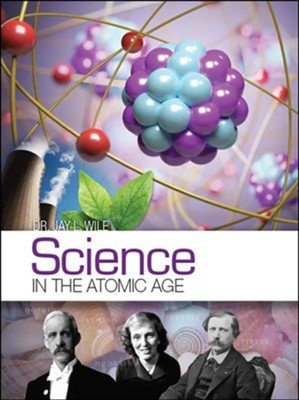
Earth Science - Jr. High
Textbook
Science in the Atomic Age by Dr. Jay L. Wile
Format
Lecture, Experiments, Reading, Homework, Tests
Description
"Introducing scientific concepts in the context of history, students will follow the work of the scientists who lived during the mid-1900s period known as "The Atomic Age." This easy-to-read text starts with an introduction to the scientific method and the role of experiments before moving on to describe the story of how scientists developed the quantum-mechanical model of the atom. They'll learn about the experiments that led to this model along with the stories of the scientists who did the experiments. Students will then build on their understanding to learn about the Periodic Table of the Elements and how to interpret it. Further chapters cover covalent and ionic compounds, the incorrect cubical model of the atom, the discovery of DNA's role in life, cells, and more. These topics are all discussed in the context of history, explaining how specific scientific advances led to today's scientific explanations. This allows students to learn not only the current scientific understanding of these topics, but also how scientists reached that understanding. As the course builds in the complexity of topics covered, students discus the living world including the levels of organization found in creation. Students learn how cells work together to make tissues, how tissues come together to make organs, how organs form organ systems, how those organ systems produce organisms, and how those organisms relate to one another in populations and communities. Students also learn how those communities interact with the physical environment to form ecosystems, which then form biomes. Chapters also cover fascinating new discoveries such as the function of the human appendix, the human microbiome, and soft tissue found in dinosaur fossils. Throughout the course, God's design in nature is highlighted, and topics in the creation/evolution debate are discussed."
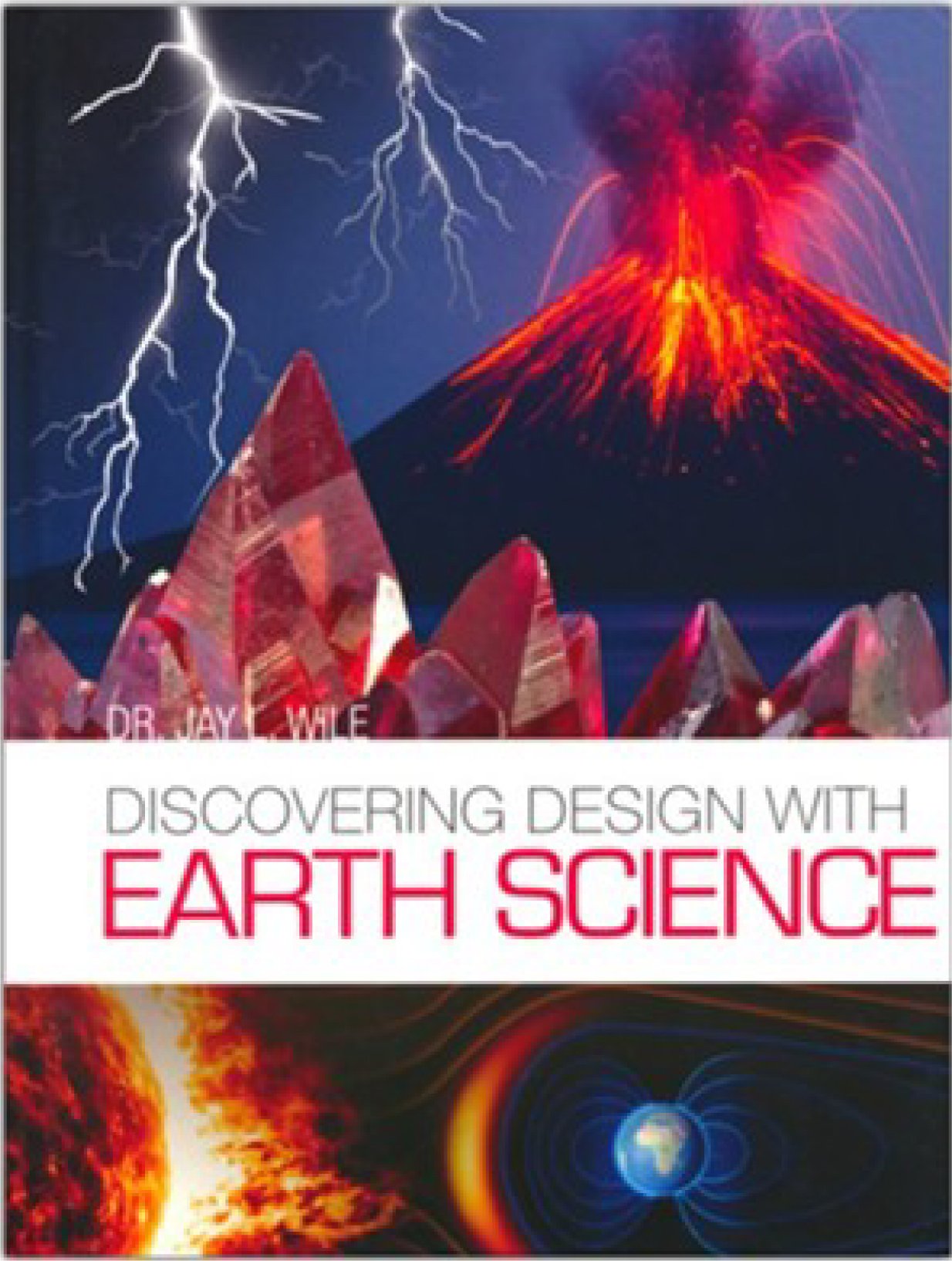
Earth Science - Jr. High / High School
Textbook
Discovering Design with Earth Science by Dr. Jay L. Wile
Format
Lecture, Experiments, Reading, Homework, Tests
Description
"It covers the general properties of the earth’s geosphere, hydrosphere, and atmosphere. Students learn about all the sections of the geosphere (such as core, mantle, crust, etc.) and then they study each in more detail. When studying the earth’s crust, they learn about minerals, rocks, and the rock cycle. Plate tectonics is then covered, which leads to a discussion of seismic waves, earthquakes, and volcanoes. Students then learn about fossils and how both uniformitarians and catastrophists interpret those fossils as well as the sedimentary rocks in which they are found. A discussion that compares uniformitarianism and catastrophism follows, in which the strengths and weaknesses of each view are covered. After that, the hydrosphere is discussed. Students first learn the properties of water such as polarity, the ability to hydrogen bond, and heat capacity. That leads to a discussion of the hydrologic cycle and residence time. Students then learn about the waves, currents, and tides in the ocean. They then move on to the ice reservoirs on the earth and then the freshwater reservoirs. Water in the air is the last part of the hydrosphere that is covered. The atmosphere is then discussed, including the composition of air, the sections of the atmosphere, temperature gradients, and pollutants. This leads to a discussion of weather. The course ends with two chapters on space, one that covers the solar system and one that covers the universe as a whole."
Biology - High School
Textbook
Discovering Design with Biology by Dr. Jay L. Wile
Format
Lecture, Experiments, Dissections, Reading, Homework, Tests
Description
“This Biology course provides an excellent High School level introduction to the concepts and structure of beginning Biology. Your student will study an overview of the five kingdoms in creation, cellular and molecular biology, genetics, and a Christian approach to evolutionary theory. Class time consists of lecture and labs. Students will complete weekly homework assignments and lab write ups. Understanding will be evaluated by exam or writing assignment for each module. ”
Chemistry - High School
Textbook
Discovering Design with Chemistry by Dr. Jay L. Wile
Format
Lecture, Experiments, Reading, Homework, Tests
Description
“This course includes sixteen chapters that together cover topics such as the classification of matter, atomic structure, spectroscopy, chemical bonding, molecular geometry, physical change, chemical change, stoichiometry, solutions, ideal gases, acid/base chemistry, reduction/oxidation reactions, thermochemistry, thermodynamics, kinetics, and chemical equilibrium. Concepts are woven together with their mathematical applications to help students learn to think like chemists.” It is highly recommended that students have completed Algebra 1 or are taking Algebra 1 if they take this class."
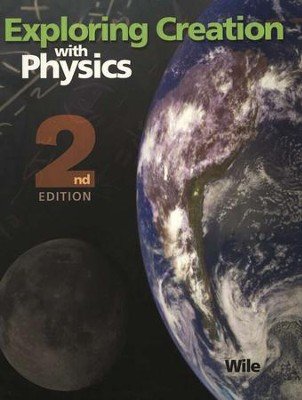
Physics - High School
Textbook
Exploring Creation with Physics 2nd Ed, Apologia
Format
Lecture, Experiments, Reading, Homework, Tests
Description
“This college-prep physics course is designed for the student who has completed algebra and has had an introduction to the definitions of sine, cosine, and tangent. It provides a detailed introduction to the methods and concepts of general physics. Heavily emphasizing vector analysis, this text is ideal preparation for a university-level physics course. It provides the student with a strong background in one-dimensional and two-dimensional motion, Newton's laws and their application, gravity, work and energy, momentum, periodic motion, waves, optics, electrostatics, electrodynamics, electrical circuits, and magnetism.”